International LoRaWAN Standards & Policies
June 2025: CEPT Resolution ECC DEC(25)02
Approved coexistence of LPD-S with satellite communications in the 862-870 MHz SRD band, a key framework for satellite-assisted LoRaWAN in Europe.
November 2021: ITU-T Y.4480 Standard
LoRaWAN approved as an international LPWAN standard, enhancing global recognition and interoperability.
2020: Italy's Decreto Semplificazioni
Lifted time limits on LoRaWAN deployments, allowing permanent networks and enabling large-scale commercial use.
2019: China MIIT Announcement No. 52
Issued technical requirements for micropower radio equipment, defining clear boundaries for LoRaWAN use in China.
Challenges in IoT Transformation
01. High Renovation DifficultyTraditional wired systems require re-wiring, leading to long construction periods, high costs, and potential disruption to operations.
Platform networking
02. Poor Signal Coverage:4G signals are severely attenuated in enclosed areas like basements and workshops, causing frequent data transmission interruptions.
03. High Communication Costs:Each device needs a separate IoT SIM card, resulting in substantial communication and management fees.
04. Large-Scale Deployment Challenges:Complex node management, configuration, and expansion in large areas can lead to network congestion.
LoRaWAN Advantages
01. Long Communication Distance
Up to 15-20 km LOS and 2-5 km urban, ideal for wide-area deployment.
02. Flexible deployment and low cost
The company platform supports the rapid self-built LoRa network, which can be directly superimposed on the original system without rewiring, realizing low-cost wireless transformation.
03. Autonomous networking and unlicensed frequency band
Based on the unlicensed frequency band (such as China 470-510 MHz), there is no spectrum license fee.
Easily build your own network, unlike NB and 4G, which rely on carrier base stations.
04. Platform level intelligent management
The platform is deeply integrated with LoRaWAN network, which supports automatic meter reading, real-time data collection, and improves operation and maintenance efficiency.
Abnormal event identification and safety early warning mechanism can realize automatic fault identification, threshold early warning and abnormal energy consumption alarm, and improve system safety and response speed.
05. Ecological openness and strong compatibility
Adopt LoRaWAN open standard, be compatible with mainstream equipment and gateway manufacturers, provide standardized API interface, and realize multi-system collaboration.
LoRaWAN Application Scenarios
01. Smart City
Urban energy and facility monitoring, including street light control, environmental sensing, and remote meter reading.
02. Industrial Park
Covers the entire park for energy monitoring, equipment status collection, lighting control, and security alarms.
03. Smart Building
Wireless data collection and control for meters, HVAC, and lighting in offices, malls, and residences.
04. Smart Factory
Applies to equipment energy monitoring, production line power collection, and environmental sensing.
05. Education & Healthcare
Monitors energy in labs and wards, and manages utility billing for staff dormitories.
Platform networking scheme

01. Network Server
Complete data acquisition task management.
Complete the analysis and query of collected data.
Complete the instrument command distribution.
02. LoRaWAN Gateway
Similar to telecom base station /WIFI router, it is installed at various locations in the project area according to the area and interference. Downlink exchanges data with LoRaWAN node, and up link exchanges data with NS platform through UDP protocol.
03. LoRaWAN Node
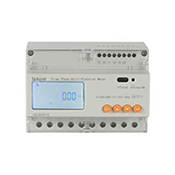
AWT100-LW and ADW300-LW are LoRaWAN nodes, which complete the field data acquisition and upload the data to lorawan gateway through LoRaWAN protocol.
Typical hardware
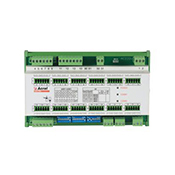
AWT100-LW
LoRaWan frequency band: CN470/EU868/AU915/AS923.
The maximum number of access devices is 30
Uplink communication protocol: LoRaWAN protocol
Downlink communication interface: RS485 interface
Downlink communication protocol: MODBUS-RTU protocol.
Compliance with standards and certification: CE-RED, IEC, LVD, EMC.
Power supply: 24Vdc (default); 85~265Vac/Vdc (via AWT100-POW module)
ADW300-LW
Lorawan frequency band: CN470/RU868/IN865/EU868/US915/AU915/KR920.
/AS923_1/ AS923_2, AS923_3, AS923_4
Standards and Certification: CE, IEC, LVD
Installation mode: guide rail type
Uplink communication protocol: LoRaWAN protocol
Measurement: three-phase active power, reactive power, current, voltage and harmonics.
Accuracy: Level 1
Rated voltage: 3×220/380Vac, 3×380/660Vac.
Rated current: 3× 1 (6) A.
AWT200-LW
LoRaWan frequency bands: 470MHz-480MHz, 863MHz-870MHz, 902MHz-928MHz.
Maximum support for centralized collection of 10,000 points.
Mass storage, support breakpoint continuous transmission
Support management tools to facilitate system configuration and maintenance.
Strong communication ability, supporting up to 8 serial ports and 8 channels of BW125KHZ LoRa data reception.
Terminal nodes can be added through NS web pages, and group management between different nodes can be supported.
Uplink communication protocol: 4G or Ethernet
Downlink communication protocol: LoRaWAN protocol.
Typical case
01. Energy consumption project of P&G plant in Singapore
02. Singapore Smart City Project