| Color: | Please select |
|---|---|
| Size: | Please select |
| Availability: | |
AWT100-AP/WFH
ACREL
Download
Product Description
| Brand:Acrel | Place of Origin:China | Application:IOT system |
Evolution of Wi-Fi HaLow Technology and New Opportunities of Internet of Things
Evolution of technical standards
Wi-Fi HaLow(IEEE 802.11ah) has gone through the technical verification period and pilot deployment period since the standard was frozen in 2016, and entered the Asia-Pacific commercial acceleration period in 2024, becoming one of the key technologies in the field of Internet of Things communication.
Technical advantages of Sub-1GHz band
Sub-1GHz band, compared with traditional 2.4GHz Wi-Fi, has the characteristics of longer transmission distance, stronger penetration and lower power consumption, and is suitable for large-scale deployment of Internet of Things.
Market orientation and application value
It fills the technical gap that traditional Wi-Fi coverage is insufficient and cellular network performance is excessive, and becomes an ideal choice for smart meter reading, industrial sensing, smart cities and other scenarios.
![]() Auxiliary power supply AC220V Terminal RJ45 Installation DIN 35mm Baud rate 2400bps-115200bps Operating temperature -20℃~55℃ |
●The physical throughput ranges from 150 kbps to 3.5 Mbps, meeting the data transmission requirements for applications from low-speed sensors to high-speed image data.
●Channel access backoff is implemented using Channel Conflict Assessment (CCA) and Carrier Sense Multiple Access with Collision Detection (CSMA/CD) mechanisms.
●The system utilizes Automatic Frequency Selection and Automatic Frequency Control to maintain optimal signal connectivity and stability.
●Supports Low Power Consumption.
●Supports Relay and Roaming.
●Supports Multicast.
Parameter
Smart Grid and Wireless Automatic Meter Reading (AMR) System Architecture
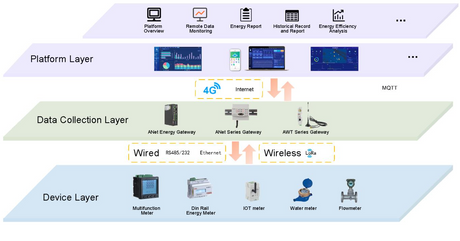
A four-layer architecture consisting of Gateway - Root AP - Terminal STA - Meter is adopted. The downlink data flows from the gateway through the Root AWT100 (AP), the WFH wireless channel, and the Terminal AWT100 (STA) to the meter; the uplink data flows in the reverse direction. This setup achieves seamless conversion of the MODBUS-RTU protocol and full-link wireless data transmission
It is suggested that the communication distance of the factory environment or urban environment is 200 meters.
The ability to penetrate the wall on the same floor (60m /5 wall, stable communication without shielding of antenna), vertical floor penetration (3 floors or less is recommended). In the complex industrial environment, it is suggested that the communication distance should be controlled within 60 meters horizontally or 3 floors vertically. In addition, in the case of long distance, it is necessary to ensure that the antenna position is relatively empty and there is no obvious barrier to ensure the real-time and reliability of Modbus communication.
Schematic diagram of anti-reflux application scheme